Work in Motriz
Validate a venture
Move an idea through evidence, checkpoints, an honest build decision, and a repository handoff.
A venture is a repository-free starting point for an idea that still needs evidence. It gives you one durable co-founder conversation, a visible nine-question journey, specialist work behind the scenes, and explicit checkpoints where continuing is only one valid outcome.
Start the venture
- Create a venture.
Name it now or let Motriz name it from the first conversation. Choose the initial co-founder model, effort, and optional Fast tier.
- Describe the idea in your own words.
The co-founder opens first. A single sentence or a rough paragraph is enough; the conversation is intentionally not a wizard.
- Answer focused questions.
As context improves, the co-founder can offer quick-answer cards grounded in what you said, while always allowing a free-text answer.
- Review the journey and evidence.
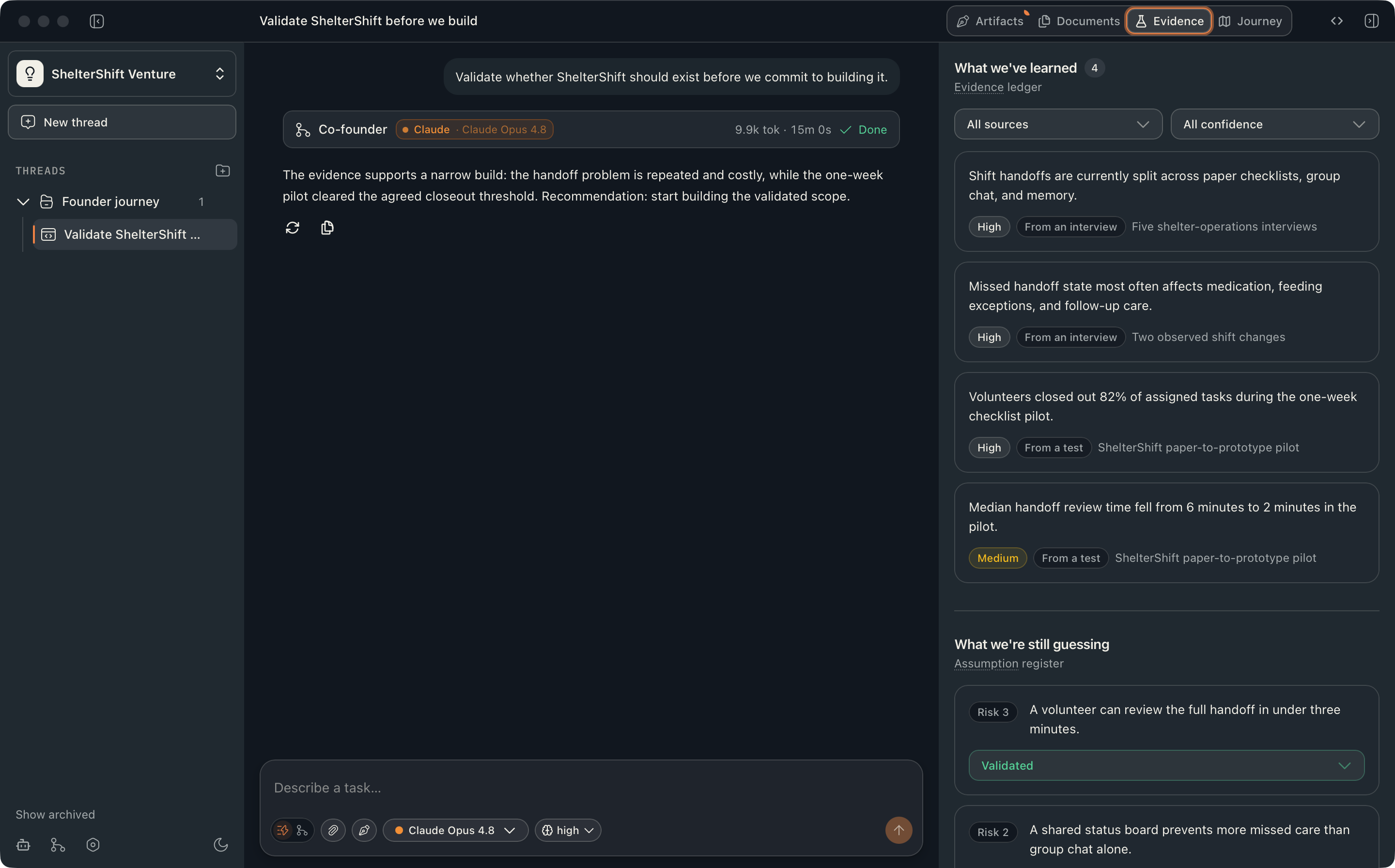
Use the workspace to see what is current, what is done, what documents exist, and what evidence supports each decision.
The three acts and nine questions
| Act | Phase | Question | Typical output |
|---|---|---|---|
| Understand | Context setup | What are we working with? | Known context and prior work |
| Understand | Raw idea capture | What's the idea? | Idea brief |
| Understand | Problem & customer | Who has this problem? | Problem frame and ICP |
| Understand | Market & landscape | What's already out there? | Market memo and competitor map |
| Validate | Validation design | How will we test it? | Validation roadmap |
| Validate | Validation execution | What did we learn? | Completed experiments and evidence |
| Decide & Build | Strategy formation | How would this win? | Strategy memo |
| Decide & Build | Build preparation | What do we build first? | MVP scope, PRD, UX flow, feasibility memo |
| Decide & Build | Build gate | Build it — or not? | Build, test more, pivot, or stop decision |
One co-founder, many specialists
You interact with one co-founder. It can bring in specialist work for customer pain, competition, market research, validation, product requirements, feasibility, risk, and other founder tasks without turning the main conversation into a list of named agents.
Some specialist roles carry a Premium preview label. In the current app, this label is informational; it does not lock the role or require a subscription.
Documents and evidence
The journey creates or updates durable venture documents instead of treating every answer as disposable chat. Canonical outputs include:
- Idea brief, problem frame, and ideal customer profile.
- Market memo, competitor map, and validation roadmap.
- Strategy memo, MVP scope, PRD, UX flow, and feasibility memo.
- Experiment results and evidence linked to the assumptions they test.
Open Documents to read the current durable outputs. Open Evidence to inspect observations and experiment results that should influence the next checkpoint.
Checkpoints and verdicts
Checkpoints force the venture to make an explicit, evidence-aware decision. The available outcomes use plain language:
- Keep going — the current question is answered well enough.
- Go back and redo — an upstream assumption or document needs more work.
- Test more first — the build gate does not yet have enough signal.
- Change direction — close the current round and seed a pivot from what the evidence revealed.
- Stop this idea — preserve the venture as a browsable evidence record.
- Start building — commit to the scoped MVP and begin the handoff.
A stopped venture keeps its documents, artifacts, evidence, and cost history. It can also seed a new pivot venture, so the learning is not lost.
Hand the venture into a build
When the verdict is Start building, the handoff packages the decisions into a code project.
- Choose where the build lives.
Keep an attached repository, create a new repository in a chosen parent folder, or select another existing repository.
- Confirm the project name.
This becomes the code project that takes over implementation work.
- Review what travels.
The PRD, MVP scope, UX flow, and evidence pack become build context.
- Review the first tasks.
Motriz seeds a durable queue from the scoped build work.
- Create the project and queue the build.
The venture enters its building stage and regains Chat, Build, Product Design, and Co-founder modes.
Return to the evidence while building
A building venture keeps Documents and Evidence available beside Files, Changes, and Artifacts. Use the Co-founder mode to sanity-check implementation decisions against the original evidence rather than restarting product context in a separate tool.